Wednesday, September 30, 2009

Show me where it hurts

The title for this post comes from a line which was used in response to a rant posted by my husband Johnie Rotten. "JR, show us on the doll, where it really hurts." That cracked us up then and we do use it from time to time and laugh about it still. To whomever it was that posted that, Thank you! Also seemed appropriate to use it, since his Birthday is TODAY! Happy Birthday Mr. Rotten!

While giving credit where it is due, I also have to mention he is the one who taught me how to check their back for soreness. Not one of the farms I have worked at over the years, Not one of the 'big name' or so called 'trainers' in any discipline, ever did it themselves or bothered to show me or the other grooms how... Nope! I learned it from him. I have also learned a lot of other things, but this is one of the simplest and most important things, as a rider, when it comes down to the horses comfort.

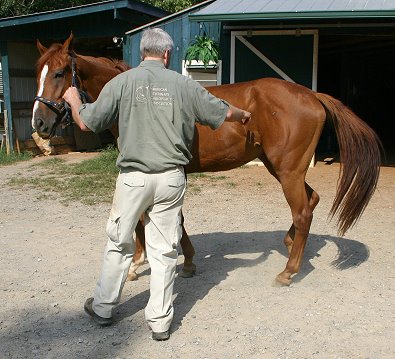
In looking for pictures (so I don't have to take my own and make everyone wait for that too!) I found this series-


Thank you Equisearch! Yes the link is to the article which also has a bit more information as far as checking your saddle fit too. I highly recommend the read and consider the information with an open mind. Their website has a lot of articles and helpful information for all levels of experienced horse people.

The one minor difference in how we check our horses backs is that we start up near the withers with a finger on one side and thumb on the other side of the spine- right about where either side of the saddles' gullet area would lay. We gently push down on the back as we slide our finger and thumb from the withers back to the hip while watching for any twitching, flinching or reaction from the horse. We apply gentle pressure at first, then a little more the second time. If there is a sore spot- your horse will feel it and you will see their response. Then as the article states we move the 'line' down to where the thumb has made a line as pictured above.

Check from both sides as you may not see a response on the right while standing on the left. Check before and after each ride. Checking before the ride can be done while you are brushing them off. Checking after, just after you have pulled the saddle and are looking for dry spots under the pad anyways. Checking after the ride is a good time to do so, as the muscles will be warm from work, but also because if there is any soreness from the pressure of the saddle and a riders weight- your horse will certainly react. It will be 'fresh' soreness, not something that has become just a dull ache, which they may have developed a tolerance of.

If minor soreness is found before a ride, I recommend doing the stretches previously discussed and then groundwork for the day. Lunge the horse, letting them warm up the muscles, relax and going around at an easy pace. Afterwards, do a few more stretches and check for soreness again. If it is minor, then perhaps the horse just needs a little extra work that is focused on stretching and relaxing that area. Maybe they just slept on the wrong side of the stall? Give them a few days of this and keep checking for an improvement.

I do not recommend saddling them during this time, simply because if the saddle is causing the pain then it may just keep putting pressure on that area and likely no improvement will be made. If the issue 'resolves itself' through this process, then start just by saddling the horse and lunging them a few days, continuing to do the stretches and checking before and after their workout. If the soreness does not reoccur, then proceed to move on to riding again- still stretching and checking before and after rides.

The minor soreness may have been a one time deal or may be caused by the saddle, but without a riders weight- not enough weight to apply pressure to that spot. If the soreness comes back, then checking your saddle and pad are certainly one place to start as well as having your horse evaluated for chiropractic care. A massage would also be something to consider as well as having their hoof care and shoeing re-evaluated for proper balance. Finding the true cause of the pain can take some effort, but once it is found and resolved, your horse will certainly be grateful.

Friday, September 25, 2009

Gotta go with what ya know...

The subject of what is best for our horses back has brought up a few things for discussion. One of them being saddle pads. There are about as many different types, brands and materials being used to make them as anyone would care to imagine.


But one of the best pad manufacturers I have found yet, hands down, is 5 Star. Give this article on their website a read and then ask yourself, which pad would I want on MY back, if things were the other way around?

The beauty in the 5 star pads, is they are made from natural fibers for one, they allow moisture to be wicked away from the horses back, the wool has a higher compression rating and tensile strength and they have nailed down the most honest part of all- if the saddle doesn't fit, extra padding is just a cover-up or temporary fix, but the problem still remains.


And they do make a line of English pads for hunter, jumper, dressage, walking horse and jockey saddles. By 'walking horse' I am guessing they mean all gaited breeds or maybe they are referring to saddleseat perhaps?

The only thing I question about the pads, is the leather strip alone the top, where the horses spine is. I question how much breath ability the leather allows or prohibits. On the English version, with the pad pushed up into the gullet area of the saddle- this is relatively not an issue. Western saddles don't often offer much room for this though. Add the thickness of what most western pads come in and this might raise a few eyebrows.

Now some may argue that their pads are expensive. And sure, a couple hundred dollars for a pad can be viewed that way. In comparison shopping though, plenty of others are around the same price, some costing even more, yet providing you with less. The main question is, how much value do you place on the comfort of your horse? What is that worth to you?

Consider how much use your pad will get, how easy it is to care for, how long it will last and what level of comfort and relief it provides. Divide the price by all of that and you may find, the the initial cost is actually pretty reasonable.

Wanna do the math? I have seen the pads for sale for anywhere around $189-$240. If I ride 3 times a week for one year- that is 156 rides. Divide $240 by 156 and you get around $1.54 per ride. So $4.62 per week or $18.48 per month. That is just for one year. I know a few of us have pads that have lasted longer than that.

By the way, 5 Star is stating their pads last 1500-2000 rides or uses. At the 3 rides per week average- the pad should last you a little over 9.5 YEARS! Just to reach the 1500 ride/use mark. Go with the 2000 ride/use claim and you are looking at 12.8 YEARS of use! I think the pad would have easily, more than paid for itself by then. You may have changed the 'color' you like a few times over those years.

If you wish to take it one step further- how much will you save, by buying a cheap pad that doesn't hold up? One that you have to keep replacing? How frequently does it need to be replaced, and over time, what has that cost you? Better yet- what has that cost your horse?

Tuesday, September 22, 2009

Ouch, Pop, Ahhhhh!

In recent posts we have discussed the different effects a saddle can have on a horses back. I have mentioned my mares withers getting rubbed raw in one spot from the saddle pad, but there are a few other things that come into play when considering your horses back.

For everything to be right in your horses world, optimally there should be no pain involved. If there is any level of pain, the horse will compensate and it will show. If their hooves are not trimmed or shod in a way that provides a balanced way of standing or traveling, it could affect a lot of things. That is another discussion in and of itself, that will be later addressed on it's own.

When a horse feels pain though, what happens then? The muscles will tend to contract in that area and tighten. There may be some inflammation, tension, resistance to move, flex or give in that direction, the 'symptoms' may be slightly noticeable or blatantly obvious. Muscles that have contracted can inadvertently 'hold' things out of place. Horses, like us humans, can benefit from chiropractic care and having an adjustment and things realigned.


In looking for pictures I came across this one from Bits & Bytes Farm, which shows Dr. Lance Cleveland doing crossing over exercises with a horse. In reading further, on this page of the B&B website, I feel there are a lot of good things to say!

If you scroll down to just above the picture I featured here, there is a link to a pdf file that you can print, that lists and explains a few stretches you can do with your horse, to help keep them limber, flexible, supple and their muscles relaxed. They also help strengthen the muscles and 'hold' the adjustment, essentially keeping things in place. One that I missed seeing on there was where you lift the front leg and bring it forward, allowing the horse to reach out and down, maybe leaning forward into it or back a bit and stretching along their top line.


This photo is from an article on Natural Matters.net in the UK, from Pat Ki Therapy where equine massage is another way of helping out the horse. Massage feels good because it helps to relax the muscles in the area, improve circulation and can often allow the horse to move more freely. Sometimes they move in a way that they may 'adjust' and realign themselves. This can happen while rolling, bucking and also sometimes while being massaged and stretching.

Weakened muscles can let things 'slip' out of place. The muscles contract from the pain and hold them there. Stretching and massage helps to relax those muscles and allow things to 'pop' back into place where they belong. Strengthening work helps the muscles keep things there. It all works in a lot of the same ways on us too. I feel better when things are where they belong, everything is stretched and relaxed, tension released... and I have yet to see a comfortable horse complain.